Organic Eat Inventory
Know what every box really costs — and what to buy tomorrow.
A homemade food delivery business sold well but couldn't see its real profit: ingredients, boxes, stickers and bags were bought in bulk and nobody knew how much each order used. I built a web app that connects recipes, sales, stock and money.
| Item | In stock | Level | Status |
|---|---|---|---|
| Basmati rice | 6.5 kg | OK | |
| Chicken | 4.2 kg | OK | |
| Spinach | 1.1 kg | Reorder | |
| Rice boxes | 120 pcs | OK | |
| Stickers | 35 pcs | Reorder | |
| Raita cups | 18 pcs | Reorder |
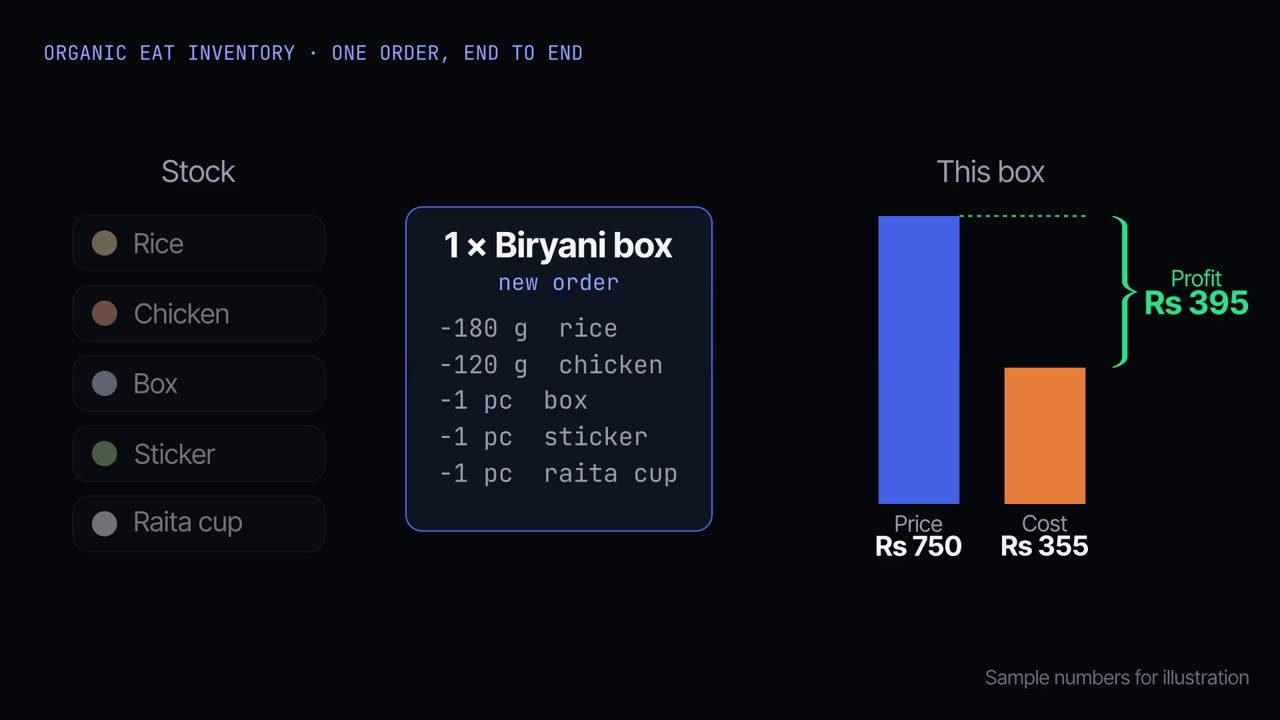
Recipes lived in a notebook — "4 kg of biryani" — but nobody knew how many boxes that made, how much packaging was left, or whether a Rs 750 box actually made money after delivery.
A web app where recipes drive the stock: each order deducts its exact ingredients and packaging, and the daily summary shows sales, costs and real profit.
From recipe to real profit.
Four connected steps — enter an order once and everything else updates.
Recipes in, not guesses
Each menu item has a recipe: ingredients per box, plus packaging — box, sticker, bag, spoon, raita cup.
Every order deducts stock
Log a sale and the system subtracts exactly what that order used, ingredients and packaging together.
Purchases add it back
Record supplier purchases with cost, and stock and average cost update automatically.
Profit per order
Revenue minus ingredient, packaging and delivery cost — so the real margin of every box is visible.
The whole kitchen, on one screen.
Built around how a small food business actually runs day to day.
Owners
A daily summary of orders, costs and profit — no spreadsheet maths at night.
Kitchen
Know before cooking whether there is enough rice, chicken and packaging for tomorrow's orders.
Purchasing
Buy the right amount, based on what actually sells and how many days of stock are left.
Running your business on spreadsheets?
I build web apps around how your business really works — orders, stock, costs and reports, connected in one place.